Hello back again for another scribe, Tuesday's class was not very difficult although very important. As we began the day with a simple question, which was "Find the volume generated between the x-axis and the graph f(x)=x^2, from x=0 to x=2. Here is the graph of x^2.
http://fooplot.com/x^2
So we begin to solve this problem by setting up the equation (0,2) ∫ πr^2 dx
= (0,2) ∫ Π(x^2)^2 dx
= (0,2) ∫ Πx^4 dx
= (0,2) ∫ Π(x^5/5) dx
= Π(2^5/5) - Π(0^5/5)
= 32Π/5
Solved.
Then Mr.K began showing us a new form in which solids of revolution can be formed, which was by rotating the function about the y-axis. The equation that represents a function about the y-axis is: V= ∫2 Πrf(x) dx Here is a problem that was worked on in class using this method.
Region S is bonded between two functions, f(x) & g(x), find the volume of the solid generating around the y-axis.
F(x)= 0.5x^2-2x+4 G(x)= 4+4x-x^2
Using the volume equation of a solid of revolution around the y-axis we get, just solve algebraically, do not solve completely:
= 2 Π (0,4)∫ x [g(x)-f(x)] dx
All in all this class was very important as the equation for a solid of revolution about the y-axis was given and explained. Remember all the rest of 8.3 was for homework. The next scribe is VAN.
Showing posts with label Definite Integral. Show all posts
Showing posts with label Definite Integral. Show all posts
Wednesday, February 13, 2008


Tuesday, February 12, 2008
Scribe #7 (I think)
Hello back again for another scribe post. Sorry in advance to everyone who was waiting for the Friday's post, i was not able to get it up because of my internet connection to the blog was timing out. Well lets get into some math. Friday's class was all about rotating functions around the X-axis. Although this functions were not lines, they were functions like the area between two parabolas, or a function that had never been seen before. It started with a simple solids of revolution function, Find the volume of a solid revolution obtained by rotating the function x^2, bounded by the lines x=2 and x=1 around the x-axis. So here is a picture of that function revolved around the x-axis.
http://fooplot.com/index.php?q0=x%5e2
So between 1 and 2 we want to find the volume of the solid of revolution. So we find that once we make a cut and pull out a piece from the solid of revolution it looks like a circle with a hole in the middle. Where x^2 is the radius of the circle So the area of the circle is A(x)=Πr^2= Π(X^2)^2 =
Π(x^4).
So the volume of the solid of revolution is V=1,2 ∫Π(x^4) dx = Π [x^5/5] 1,2 = [32Π/5] - [1Π/5] = 31Π/5.
After this question we took up questions in our homework from the previous night that we were not able to complete. The next scribe is going to be Dino once again.
http://fooplot.com/index.php?q0=x%5e2
So between 1 and 2 we want to find the volume of the solid of revolution. So we find that once we make a cut and pull out a piece from the solid of revolution it looks like a circle with a hole in the middle. Where x^2 is the radius of the circle So the area of the circle is A(x)=Πr^2= Π(X^2)^2 =
Π(x^4).
So the volume of the solid of revolution is V=1,2 ∫Π(x^4) dx = Π [x^5/5] 1,2 = [32Π/5] - [1Π/5] = 31Π/5.
After this question we took up questions in our homework from the previous night that we were not able to complete. The next scribe is going to be Dino once again.
Wednesday, February 6, 2008
The Scribe: Slices of Bread

Hello, I am known as Tim-math-y on our blog, and I will be the Scribe for today's lessons.
The Overview:
Today, we discussed the concept of "How to Build a Solid." By rotating certain functions about the x-axis, three dimensional solids were formed, upon which we could use calculus to solve for the unknown volume. We found that the solution to calculating such values, especially with irregular shapes, involved the idea of Bread Slices. These concepts will be thoroughly discussed throughout this scribe post.
The Introduction:
To begin the class, we started off with a concept we were already familiar with: areas between curves. We were given three questions that would lead us into our main lesson of today. They all involved similar steps, and did not present any new difficulties. Calculators were not permitted to solving the first two, but for the third one, they were permitted as the algebraic calculations could become disorganized and difficult.
 This was our first question. As one may see, it involves a set of three major steps.
1.) First, we set up an equation in hopes of solving for the points of intersections, shared by the two functions. We set each function on opposite sides of the equation and algebraically solve for the value of 'x'.
2.) Second, we attempt to find which function is 'on top of the other'. This may be done by plotting both functions onto a coordinate plane or using a number line.
3.) Third, we subtract the two areas underneath each curve (area1 - area2, where area1 maintains the upper position). To find the areas underneat each curve, bounded by the x-axis, we used integration, from 'a' to 'b', where a = 0, and b = 1 in this question.
By solving, we calculated the area bounded by the pair of functions.
The Next two questions given included the same ideas and concepts for finding the solution. What is more important however, is how this connected to the concept that we learned today.
The Focus: Volumes by Slicing
Included are exerpts from the textbook (Calculus; Concepts and Calculators), hopefully to provide insights
 The method we use to compute the volume of certain solids revolves about using the definite integral. By dividing the solid into small pieces whose volume we can easily approximate, we can compute the volume. As the number of terms in the sum grows larger and larger, the approximation improves and the limiting values is a definite integral.
For any solid that has a constant cross-section its volume is the product of its cross-section area 'A' and its thickness '(delta) x'. Most solids do not have regular shapes and the task of computing their volumes requires calculus methods.
Imagine a loaf of bread lying along the x-axis in the xy-plane between x = a and x = b.
The loaf can be divided into several slices by making cuts perpendicular to the x-axis. The volume of the loaf is the sum of the volumes of all of the individual slices. In general, since the shape of the loaf varies, different slices have different volumes even if they all have the same thickness.
For any 'x' between 'a' and 'b', let A(x) represent the cross-sectional area created by the cut at x. Suppose we divide the loaf into n slices of thickness (delta) x = (b - a)/ n. The cross-sectional area of a typical slice is not constant. However, if we replace it with a slice of the same thickness and constant cross-sectional area given by one face of the slive, then the volume of this slice is:
Volume of one slice = A(x) * (delta) x
To estimate the volume of the whole loaf, divide it into n pieces of equal thickness: (delta) x = (b - a)/ n , by making cuts at a = x0, x1, x2 ... xn = b.Using the cross-sectional areas A(x1), A(x2), ... , A(xn) for the individual slices leads to an estimate for total volume.
Total Volume = A(x1)(delta)x + A(x2)(delta)x + ... + A(xn)(delta)x
This is a Reimann sum for the cross-sectional area function A(x) on the interval [a,b]. Thus, the limiting value as n grows larger and larger is the definite integral concluded below:
 Coming back to our class lesson, we looked at an example question:
 In this situation, the linear function, within the interval of [0,8], was 'spun' around the x-axis to for a coned solid. We found that, by slicing the solid into smaller pieces, we could find the volume of the given piece. In this case, each piece took the shape of a cylinder, where its volume could be expressed as: area x height, where area is (pi)r^2, and height is the subinterval of (delta)x.
As the amount of slices grew to infinity, or in other words, let (delta)x become infinitely small, the integral of the area would compute the volume of the solid.
We then continued our calculations to solve for the volume:
 Here, we found the volume of the coned solid to be 128(pi)/3. Referring back to the original equation for solving a volume of a cone, we checked whether or not our solution was correct.
 By inputting the given values of 'r' (4) and 'h' (8), we found that our calculations were indeed correct.
Finally, there was one final concept that Mr. K parted to us. It was a brief explanation as to how to solve these type of questions:

The solution is as simple as the slide. To solve for the volume of a given solid, such as this, we utilize the same techniques. To solve this question, we find the area of the shaded portion. Simply put, we find the area by using subtraction: A2 - A1.
That concludes our lesson today. I hope that any of the readers found this somewhat helpful, if required. I just thought I'd add a slight more effort in today's scribe post.
I found a link to a site that provided me with some animations, to help anyone who wishes to visualize such shapes to a greater extent:
http://curvebank.calstatela.edu/volrev/volrev.htm
I'm not sure if we were assigned homework. However, I'm guessing exercise 8.2. We will continue this topic the following day, said Mr. K.
That's all everybody! Tomorrow's scribe will be: Dino, the first name that popped into my head. Good night everyone!
Tuesday, January 22, 2008
My 7th scribe for Monday
My slideshare scribe... it seems more squished than it's supposed to be, but I guess that's okay. I gotta edit it over anyways. Enjoy!

Thursday, November 1, 2007
Bob 2
My oh my!! I almost forgot about this. Well then, this unit was pretty short. It was a little challenging. I can definitely say that I don't like it being last period everyday. However, I'm managing to make my way through. This unit isn't too hard to grasp though. So good luck to everyone on the test! (:
BOB
Well, its just that time again. Another test has arrived; definite integrals. There isn't much for me to say other than that this unit was a breeze for me and so i shouldn't run into much problems on the test. Can't believe i almost forgot to do my reflection.
Goodluck everyone.
Goodluck everyone.
Wednesday, October 31, 2007
BOO!!! It's my Halloween BOB
Hmmm... where to start, where to start...
Well, this unit has been fairly interesting because of its relation with the previous unit. Now I can begin to see how everything in Calculus ties together. I have enjoyed this unit quite a bit because it has a decent amount of material that relates to Physics...
As well, it is fairly straight forward with the math, not a lot of outside the box thinking...
A key thing to remember is:
- There is more than one way to find the integral of a function
1. Using the formula: lim(n-->∞) [ f(x1)•∂x1 + f(x2)•∂x2 + ... f(xn)•∂xn ]
2. The Riesum Program in our Calculators:
LEFT: (left side of the interval)
RIGHT:(right side of the interval)
X CHOICE: (0=Left Estimate)
(0.5=Midpoint Estimate)
(1=Right Estimate)
N: (number of sub intervals)
3. "fnInt" function in our calculators: fnInt(Y1, X, min, max)
4. the function "∫ ƒ(x)∂x" in the 2nd Trace (Calc.) Menu
5. Calculate it Manually: LEFT ESTIMATE: Sum of all "ƒ(x)"s, minus the last "ƒ(x)" then multiplied by ∂x.
RIGHT ESTIMATE: Sum of all "ƒ(x)"s, minus the first "ƒ(x)" then multiplied by ∂x.
TRAPEZOID SUM 1: Sum of the first "ƒ(x)", the last "ƒ(x)", and (2 • all the "ƒ(x)"s in between) Then multiplied by ∂x. Finally divide by 2.
TRAPEZOID SUM 2: (LEFT ESTIMATE + RIGHT ESTIMATE) /2
Well, that's pretty much all for my BOB, good luck tomorrow... and:

KEEP PUSHING, and maybe, just maybe, that rock will stay at the top...
Well, this unit has been fairly interesting because of its relation with the previous unit. Now I can begin to see how everything in Calculus ties together. I have enjoyed this unit quite a bit because it has a decent amount of material that relates to Physics...
As well, it is fairly straight forward with the math, not a lot of outside the box thinking...
A key thing to remember is:
- There is more than one way to find the integral of a function
1. Using the formula: lim(n-->∞) [ f(x1)•∂x1 + f(x2)•∂x2 + ... f(xn)•∂xn ]
2. The Riesum Program in our Calculators:
LEFT: (left side of the interval)
RIGHT:(right side of the interval)
X CHOICE: (0=Left Estimate)
(0.5=Midpoint Estimate)
(1=Right Estimate)
N: (number of sub intervals)
3. "fnInt" function in our calculators: fnInt(Y1, X, min, max)
4. the function "∫ ƒ(x)∂x" in the 2nd Trace (Calc.) Menu
5. Calculate it Manually: LEFT ESTIMATE: Sum of all "ƒ(x)"s, minus the last "ƒ(x)" then multiplied by ∂x.
RIGHT ESTIMATE: Sum of all "ƒ(x)"s, minus the first "ƒ(x)" then multiplied by ∂x.
TRAPEZOID SUM 1: Sum of the first "ƒ(x)", the last "ƒ(x)", and (2 • all the "ƒ(x)"s in between) Then multiplied by ∂x. Finally divide by 2.
TRAPEZOID SUM 2: (LEFT ESTIMATE + RIGHT ESTIMATE) /2
Well, that's pretty much all for my BOB, good luck tomorrow... and:

KEEP PUSHING, and maybe, just maybe, that rock will stay at the top...
BOB
Well, this unit about definite integrals was an easy one for me. I felt like I understand all the concepts and do all the homework without stressing too much or even asking my sister. I am really confident that this test shouldn't be too hard, but as for precautionary measures, I will just make sure that i study well for tomorrows test. I hope that everyone will get a good mark on tomorrow's test. Study well and good luck.
BOBling
Hello everyone, and it is time for our second bob for the ap calculus class of 07-08. It is too bad I could not attend school today as I attended a United Way Leadership convention/workshop spanning the entire school day instead. Though, I have been present for the majority of our most recent unit, and must agree with Graeme when I say that I too feel very confident going into this unit's test. I believe that the test shouldn't be too much of a challenge, and that most of our class should handle the test with remarkable ease tomorrow. I can't recall any tribulations I encountered throughout this unit or in the pre-test, and the exercises found in our textbook weren't exactly that difficult so this test should not present too many unfamiliar questions. All I can say is that I'm not worrying too much about this test, but am definitely excited to begin my favorite unit in calculus--differentiation. Well, I guess that's really all I can say for this BOB, though the test doesn't seem particularly challenging (though it is Mr. K) I probably will still further my preparation for the test by completing more exercises or questions pertaining to this unit as should everyone in the class. I wish everyone, along with myself, good luck on tomorrow's test! Good night everyone!
Bobbin'
Well I have to say I seem to get this unit fairly well. Enough so that I feel confident that I will get a good mark on the test. Especially after that pretest, felt pretty good throughout that. Must say this has been far easier than grade 12 so far. I wish you all luck on the test!
BOB 2
Well it's time to bob for the second time now. I have found this unit much lighter and easier then the second one. I feel much better about myself going into this test. I hope to do well on the test and wish luck to everyone else. I pretty much understand everything in the unit and had fun with integrals. Now it's just a matter of applying it on the test! Well good luck to you all and do well. Bye!
Tuesday, October 30, 2007
13-0-13 V. 2
Hello!
It seems I find myself blogging on blogging again! This unit went by pretty quickly, especially since there were only 4 parts in the textbook in Chapter 3. I was actually quite surprised that I have been understanding and getting most of the questions because usually I'm quite confused. I've been doing all right in the group work so hopefully I will be able to do well on the test. The pretest was all right I got most of it right which is good and things cleared up when we had discussed things with our group and in our MEGAGROUP during the fire drill. Each time I got something right I got super excited! I really hope that I do well on the test, actually I hope we all do well. Good luck to everyone!
It seems I find myself blogging on blogging again! This unit went by pretty quickly, especially since there were only 4 parts in the textbook in Chapter 3. I was actually quite surprised that I have been understanding and getting most of the questions because usually I'm quite confused. I've been doing all right in the group work so hopefully I will be able to do well on the test. The pretest was all right I got most of it right which is good and things cleared up when we had discussed things with our group and in our MEGAGROUP during the fire drill. Each time I got something right I got super excited! I really hope that I do well on the test, actually I hope we all do well. Good luck to everyone!
Pre-Test Scribe
Hello everyone. I’m Robert and I am the scribe for today.
Today’s class started off with a discussion about blogging in other classes other than a math class. We talked about how important blogging was in our calculus class and compared to other classes. Feel free to give your opinions about blogging in your school or classroom in the comments to this post!
After that very interesting discussion on blogging, Mr. Kuropatwa told us about two other very cool tools to put in our tool box. Here they are:
Sketchcast.com
&
http://www.blogger.com/www.scribd.com
Feel free to explore!
Then we moved onto the pre-test. To see what the pre-test looks like, just look to the slides for October 30, 2007.
Today’s class started off with a discussion about blogging in other classes other than a math class. We talked about how important blogging was in our calculus class and compared to other classes. Feel free to give your opinions about blogging in your school or classroom in the comments to this post!
After that very interesting discussion on blogging, Mr. Kuropatwa told us about two other very cool tools to put in our tool box. Here they are:
Sketchcast.com
&
http://www.blogger.com/www.scribd.com
Feel free to explore!
Then we moved onto the pre-test. To see what the pre-test looks like, just look to the slides for October 30, 2007.
To end off the class we had a fire drill.
Well that's it guys, and the next scribe is MrSiwWy.

Monday, October 29, 2007
Scribe (O.o)
Hello, I'm Tim-Math-y and I will be your scribe for today's class lessons. Today, we started off class by going over the requirements for scribe posts.
Remember that you are required to label your posts accordingly, especially your scribe posts. You are required to label your scribes with your name, unit, and most importantly, 'scribe'. Without labelling your scribe with 'scribe' is equivalent to not placing your name on your work; you will not receive credit due to completion on the scribelist (If you have not already fixed your labels, you should as soon as possible).
Next, we talked about del.icio.us accounts. If you have not already signed up for one such account, it is required as soon as possible. Remember to check out other tags in math, calculus, and the such for sites that other people found extremely useful. These sites will be helpful in contributing aid in our learning outside of the class.
After the brief run overs of these topics, we continued onto learning MATH! Today, we had a workshop to prepare us for a Pretest tomorrow and a Test on Thursday.
 1.a) For this question, we simply solved the lower and upper estimates using our calculators. We placed the equation f(x) = 4x - x^2 into y1 and used our RIESUM program to solve from the interval of [0,1]. Our solutions were L(4) = 1.28125 and U(4) = 2.03125.
1.b) We simply subtract the lower estimate from the upper estimate.
1.c) Here, we sketched 4 sub intervals on the interval of [0,1] of f(x). Here we geometrically sketched the upper and lower estimates to represent U(4) - L(4). The left sketch is incorrectly scaled whereas the right sketch is a correct drawing.
1.d) We used the equation: Error = |f(b) - f(a)| x ((b-a)/n) to solve. Here, 'b' is equal to 1 where 'a' is equal to 0.
 2.) Here, we analysed the table to find out how we could estimate the integral on the interval of [-2,4]. Considering the fact that we need 3 sub intervals, we found that from (-2) -> (4) was 6 and so we could easily divide the information into 3 sub intervals. Here, we found the midpoint of 1.98 and 2.04 which was 1.03, midpoint of 2.04 and 9.64 which was 5.74, and the midpoint of 9.64 and 26.29 which was 16.82. We then added the three numbers and multiplied the sum by 2, because the subintervals maintained the length of 2. We found the result of 47.18 (Credit goes to Craig's group)
Another group attempted something different. They plotted the points onto the statplot using their calculators and simulated a similar quadratic graph. The solution was fairly close (46.5248) however despite the 99% accuracy, the answer was incorrect as it was not as accurate using the information given.
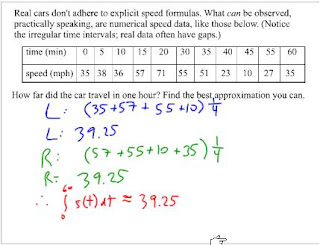 3.) Here, Chris' group attempted to solve the problem. He came up with the idea to use four subintervals, seeing that the information given could not be broken up properly into 5s nor 10s and so he broke them into groups of 15s. This brought forth much sense. However, the answer was not the best approximation as he did not use all the information given.


Here, Craig's group again brought forth a solution. They used the RIESUM formula to find the best approximations on seperate intervals (the riesum finds the sum of the lower and upper estimates and divides it by 2). The intervals were: [0,20] which had intervals of 5 minutes, [20,30] which had an interval of 10 minutes, [30,45] which had intervals of 5 minutes, [45,55] which had an interval of 10 minutes, and [55,60] which had an interval of 5 minutes.
Adding together all the solutions, he found a more accurate approximation because he used all of the information given, despite the extreme excess of work compared to Chris' method.
Remember that you are required to label your posts accordingly, especially your scribe posts. You are required to label your scribes with your name, unit, and most importantly, 'scribe'. Without labelling your scribe with 'scribe' is equivalent to not placing your name on your work; you will not receive credit due to completion on the scribelist (If you have not already fixed your labels, you should as soon as possible).
Next, we talked about del.icio.us accounts. If you have not already signed up for one such account, it is required as soon as possible. Remember to check out other tags in math, calculus, and the such for sites that other people found extremely useful. These sites will be helpful in contributing aid in our learning outside of the class.
After the brief run overs of these topics, we continued onto learning MATH! Today, we had a workshop to prepare us for a Pretest tomorrow and a Test on Thursday.
Workshop
 1.a) For this question, we simply solved the lower and upper estimates using our calculators. We placed the equation f(x) = 4x - x^2 into y1 and used our RIESUM program to solve from the interval of [0,1]. Our solutions were L(4) = 1.28125 and U(4) = 2.03125.
1.b) We simply subtract the lower estimate from the upper estimate.
1.c) Here, we sketched 4 sub intervals on the interval of [0,1] of f(x). Here we geometrically sketched the upper and lower estimates to represent U(4) - L(4). The left sketch is incorrectly scaled whereas the right sketch is a correct drawing.
1.d) We used the equation: Error = |f(b) - f(a)| x ((b-a)/n) to solve. Here, 'b' is equal to 1 where 'a' is equal to 0.
 2.) Here, we analysed the table to find out how we could estimate the integral on the interval of [-2,4]. Considering the fact that we need 3 sub intervals, we found that from (-2) -> (4) was 6 and so we could easily divide the information into 3 sub intervals. Here, we found the midpoint of 1.98 and 2.04 which was 1.03, midpoint of 2.04 and 9.64 which was 5.74, and the midpoint of 9.64 and 26.29 which was 16.82. We then added the three numbers and multiplied the sum by 2, because the subintervals maintained the length of 2. We found the result of 47.18 (Credit goes to Craig's group)
Another group attempted something different. They plotted the points onto the statplot using their calculators and simulated a similar quadratic graph. The solution was fairly close (46.5248) however despite the 99% accuracy, the answer was incorrect as it was not as accurate using the information given.
 3.) Here, Chris' group attempted to solve the problem. He came up with the idea to use four subintervals, seeing that the information given could not be broken up properly into 5s nor 10s and so he broke them into groups of 15s. This brought forth much sense. However, the answer was not the best approximation as he did not use all the information given.

Here, Craig's group again brought forth a solution. They used the RIESUM formula to find the best approximations on seperate intervals (the riesum finds the sum of the lower and upper estimates and divides it by 2). The intervals were: [0,20] which had intervals of 5 minutes, [20,30] which had an interval of 10 minutes, [30,45] which had intervals of 5 minutes, [45,55] which had an interval of 10 minutes, and [55,60] which had an interval of 5 minutes.
Adding together all the solutions, he found a more accurate approximation because he used all of the information given, despite the extreme excess of work compared to Chris' method.
End of Workshop
Word of the Day: Ginkgo - a herbal remedy derived from Jap/Chi tree to improve mental function and circulation.
Tomorrow's Scribe: aichelle s. Show them a nice scribe =)
Reminders: Tomorrow Pretest, Workshop Wednesday, Test Thursday
Have a great night everyone! Good luck on the pretest and test this week! Don't forget to BOB also! Good night!
Word of the Day: Ginkgo - a herbal remedy derived from Jap/Chi tree to improve mental function and circulation.
Tomorrow's Scribe: aichelle s. Show them a nice scribe =)
Reminders: Tomorrow Pretest, Workshop Wednesday, Test Thursday
Have a great night everyone! Good luck on the pretest and test this week! Don't forget to BOB also! Good night!
Saturday, October 27, 2007
Scribe
Hello. I'm Sandy and I'll be your scribe for this weekend. Friday's class started off like every other class we have... Graeme putting the Word of the Day on the board. Friday's word was...
Bacchanalia: "Generally just a wine festival but really is a wine festival in honor of Dionysus. (Greek god of horses and drunkenness) (Poseidon is lord of horses)."
Del.icio.us
If you don't have a Del.icio.us account yet, you should make one!
Http://del.icio.us/
Your username should not include your last name. If you're having trouble you can add the class blog and your first name.
Example: Sandyapcal07
Assignment: Find one link for each unit that we've studied and add it to Del.icio.us. It can be anything, but at least put some effort into it and don't just pick the first website you see. So far you have two links to add, Pre Calculus and Derivatives.
Screen-O-Matic
This is a program on the Internet that you can use to actually record whatever happens on your desktop as well as your voice. The files are pretty big, though.
Also, if you've already downloaded the Smart Board software, you can use that to do the same thing. Again the files are pretty large.
You go to Smart Board Software and then you click on Smart Recorder.
Workshop!
question 1:

Everything in this question is pretty straight forward. Thanks to Graeme, its even colour coordinated. (:
Question 2:

The same applies for this question.
Question 3:

This is also pretty straight forward. You can put this into your calculator too.
Simply type in the equation into "Y=", then press "2nd" + "Calc". Press up so that you're at the bottom option and press enter. You'll be on the graph screen. Press "-1", "enter", "5", "enter". And you'll see the results. As a result, the answer is 12. Which Van has stated above. (:
That's all folks!
Next Scribe ...
Timmy!! .. (=
Bacchanalia: "Generally just a wine festival but really is a wine festival in honor of Dionysus. (Greek god of horses and drunkenness) (Poseidon is lord of horses)."
Del.icio.us
If you don't have a Del.icio.us account yet, you should make one!
Http://del.icio.us/
Your username should not include your last name. If you're having trouble you can add the class blog and your first name.
Example: Sandyapcal07
Assignment: Find one link for each unit that we've studied and add it to Del.icio.us. It can be anything, but at least put some effort into it and don't just pick the first website you see. So far you have two links to add, Pre Calculus and Derivatives.
Screen-O-Matic
This is a program on the Internet that you can use to actually record whatever happens on your desktop as well as your voice. The files are pretty big, though.
Also, if you've already downloaded the Smart Board software, you can use that to do the same thing. Again the files are pretty large.
You go to Smart Board Software and then you click on Smart Recorder.
Workshop!
question 1:
Everything in this question is pretty straight forward. Thanks to Graeme, its even colour coordinated. (:
Question 2:
The same applies for this question.
Question 3:
This is also pretty straight forward. You can put this into your calculator too.
Simply type in the equation into "Y=", then press "2nd" + "Calc". Press up so that you're at the bottom option and press enter. You'll be on the graph screen. Press "-1", "enter", "5", "enter". And you'll see the results. As a result, the answer is 12. Which Van has stated above. (:
That's all folks!
Next Scribe ...
Timmy!! .. (=
Friday, October 26, 2007
Thursday, October 25, 2007
Wednesday, October 24, 2007
Subscribe to:
Posts (Atom)

